
2024 Annual Review
>2,500
hours spent on
sourcing & selection
8
grants
made
691,500
USD disbursed
across grants
31,230
WELLBYs created*
*A WELLBY is a 1-point increase in life satisfaction on a 0-10 scale for one year.
EXECUTIVE SUMMARY
Lily Yu
Fund Manager

Peter Brietbart
Fund Manager
As we close our first full year, the Bloom Wellbeing Fund is proud to reflect on a period of purposeful growth, learning, and early impact.
Full managers’ insights
Over the past year, we have made strategic grants to both established and emerging organisations delivering evidence-based, low-cost mental health interventions across low- and middle-income countries. These investments are expanding access to care where it is most constrained – and where the returns, in human wellbeing, are often greatest.
Alongside frontline delivery, we have supported innovative research and field-building efforts across wellbeing policy, psychedelic clinical trials, and the design of large-scale national and international wellbeing surveys. We have also worked closely with partner organisations to strengthen the measurement of impact, supporting several charities to explore subjective wellbeing and WELLBYs as core metrics for evaluating effectiveness.
2024 was also a year of institutional maturation.
Bloom became a fully independent organisation in September 2024, strengthening our governance and long-term sustainability.
In December, we secured a new core funder for our grantmaking programme, expanding our capacity to deploy capital responsibly and at scale. We also joined the Mental Health Funding Circle as a funding member, contributing grants to three highly effective charities and deepening our collaboration within the global mental health funding ecosystem.
2024 Grant Impact
In practical terms, 31,230 WELLBYs in low-resource settings may represent thousands of people experiencing meaningful, lasting improvements in their lives.
For context, a one-point increase in life satisfaction is comparable to lifting a person out of depression, or enabling two people to escape the despair of long-term unemployment.
This is the scale of change these grants represent – translating into calmer households, children better able to concentrate in school, parents regaining optimism, and communities beginning to rebuild stability and hope..
This first year has affirmed our conviction that rigorous evidence, thoughtful capital allocation, and long-term partnership can produce measurable improvements in human wellbeing. We remain deeply grateful to our funders and partners for making this work possible, and we look forward to building on this foundation in the years ahead.
Grants Summary
| Grantee | Project | Category | Grant | Qtr | WELLBYs/ $1k | Total WELLBYs |
|---|---|---|---|---|---|---|
| World Wellbeing Movement | Wellbeing Policy | Ecosystem | $140,000 | 24Q1 | 53 | 7,420 |
| Healing Breakthrough | New effective treatments for PTSD | Charity | $80,000 | 24Q1 | 27 | 2,160 |
| Dr Alberto Prati, University of Oxford | Wellbeing measurement surveys | Research | $6,500 | 24Q1 | ||
| Friendship Bench | Task-shifted CE psychotherapy | Charity | $150,000 | 24Q2 | 53 | 7,950 |
| StrongMinds | Task-shifted CE group psychotherapy | Charity | $100,000 | 24Q2 | 47 | 4,700 |
| Vida Plena | Task-shifted CE group psychotherapy | Charity | $75,000 | 24Q4 | 8 | 600 |
| Same Same Collective | Digitally delivered CBT for LGBTQIA youth | Charity | $60,000 | 24Q4 | 48 | 2,880 |
| Sangath | Task-shifted CE psychotherapy | Charity | $80,000 | 24Q4 | 69 | 5,520 |
| Total | $691,500 | Total | 31,230 |
Global Reach
In 2024, Bloom’s grants supported projects in 10 countries, 8 of which were LMICs.
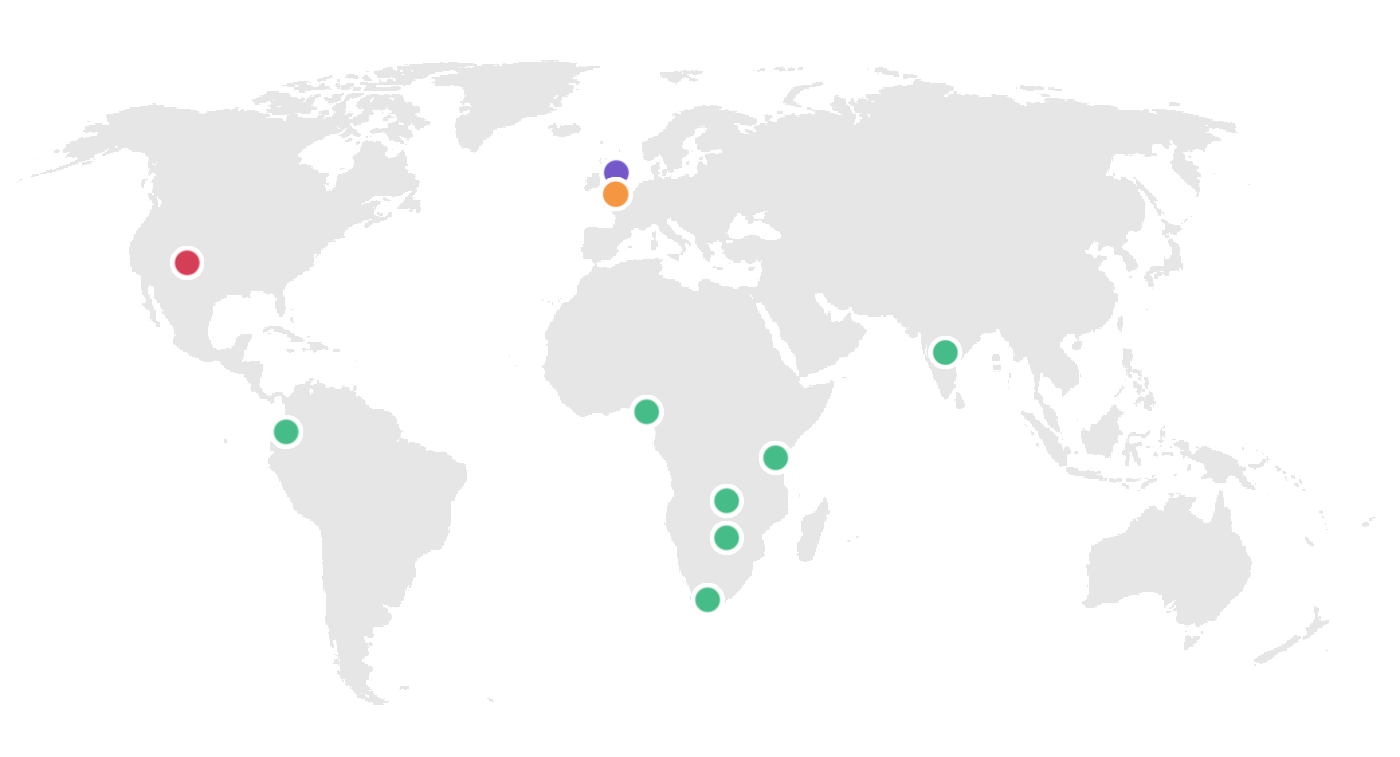
Mental health
Policy and ecosystem building
Wellbeing research
New therapies
Looking forward: 2025 goals
Grants
Bloom will continue to deploy capital thoughtfully and rigorously, prioritising evidence, learning, and real-world impact.
Conduct WELLBY-based cost-effectiveness analyses and in-depth evidence reviews for more than 25 organisations.
Make 10–15 grants to high-potential charities delivering scalable mental health and wellbeing interventions.
Allocate over 70% of our donor-advised fund (DAF) balance (based on the 1 January 2025 balance) to active grantmaking.
Direct more than 50% of total grant value (USD) to charities operating in low- and middle-income countries (LMICs).
Systematically collate outcome data, learning milestones, and implementation insights from all grantees to strengthen future funding decisions and sector learning.
Ecosystem Development
Bloom sees ecosystem-building as essential to achieving impact at scale and shifting norms toward evidence-informed philanthropy.
As a member of the Mental Health Funding Circle since Autumn 2024, Bloom has been invited to serve as Co-Chair from Spring 2025.
Develop at least three co-funding opportunities with aligned funders to jointly support high-impact global wellbeing and mental health initiatives.
Support peer organisations and intermediary agencies to provide technical assistance to LMIC-based charities, particularly on measuring subjective wellbeing and using evidence to assess impact.
Collaborate with philanthropic networks, development finance actors, high-net-worth individuals, and ecosystem builders—including Nexus Global and Forward Global—to help catalyse greater flows of capital toward evidence-based mental health and wellbeing interventions.
Fundraising
Bloom’s fundraising strategy centres on trust, partnership, and long-term alignment.
Continue to build deep relationships with donors, with a focus on welcoming new high-net-worth individuals into evidence-informed mental health philanthropy.
Leverage Bloom’s role within the Mental Health Funding Circle to influence and mobilise a significantly larger pool of philanthropic capital than we directly manage, amplifying our impact well beyond our own balance sheet.
NEW GrantEEs
This quarter, Bloom recommended grants to three organisations delivering high-impact, evidence-based mental health interventions in low- and middle-income countries. Together, these grants reflect our focus on cost-effective delivery, strong implementation pathways, and learning that can inform the wider field.
Sangath
Grant Size
$80,000
Focus area
Mental Health Intervention
Location
India
69
WELLBYs / $1k
5,520
WELLBYs total
Bloom’s first grant in Asia supports Sangath, a leading India-based non-profit with deep expertise in community mental health delivery and research.
This grant will enable Sangath to establish and implement IMPRESS (IMPlementation of evidence-based facility and community interventions to reduce the treatment gap for depression), a programme grounded in the Healthy Activity Programme (HAP)—a lay counsellor–delivered psychotherapy for severe depression integrated into primary care. IMPRESS will be delivered through government-funded health and wellness centres across Goa, with Sangath training community healthcare workers to provide HAP locally.
By decentralising care, IMPRESS reduces travel and access barriers for people with depression, while allowing limited specialist resources in urban centres to be reserved for those with the most severe needs. The programme will also leverage community volunteers to increase demand for care and improve client retention.
Vida Plena
Grant Size
$75,000
Focus area
Mental Health Intervention
Location
Ecuador
8
WELLBYs / $1k
600
WELLBYs total
Bloom’s first grant in Latin America supports Vida Plena, the first and only non-profit organisation in Ecuador delivering Group Interpersonal Therapy (IPT)—a WHO-recommended, first-line treatment for depression in LMICs.
Despite Ecuador ranking among the unhappiest countries globally in a 2021 Gallup poll, just 0.04% of the national health budget is allocated to mental health. Vida Plena is addressing this gap through scalable, community-based delivery of IPT, with a strong emphasis on learning, data, and cost discipline. Bloom was particularly impressed by the team’s openness to evidence, their operational maturity, and their active efforts to improve cost-effectiveness (reducing per-participant costs from USD 233 to a projected USD 180 in 2025).
Having supported approximately 500 people in 2023 and 700 in 2024, this grant will help Vida Plena scale services to four regions in Ecuador—prioritising rural and Indigenous communities—and strengthen partnerships with government and international development actors. Their goal is to reach 2,000 people in 2025.
Same Same
Grant Size
$60,000
Focus area
Mental Health Intervention
Location
South Africa & Nigeria
48
WELLBYs / $1k
2,880
WELLBYs total
Bloom’s final grant of the quarter supports Same Same, a non-profit developing cost-effective, digital mental health solutions for LGBTQI+ youth in South Africa and Nigeria.
Across much of sub-Saharan Africa, LGBTQI+ youth face discrimination, stigma, and limited access to safe, affirming mental health services. Many experience negative attitudes from healthcare providers and lack trusted spaces to discuss their wellbeing. Digital interventions—particularly those offering privacy and anonymity—can play a critical role in closing this gap.
Same Same has developed a WhatsApp-based chatbot delivering a self-guided, multi-session cognitive behavioural therapy (CBT) programme adapted from AFFIRM, an evidence-based intervention shown to reduce depression and improve coping and self-efficacy among LGBTQIA+ youth. AFFIRM has been trialled in multiple high- and middle-income contexts, including Mexico, Hong Kong, the United States, Denmark, and Canada. Same Same aims to adapt and rigorously test this approach for sub-Saharan Africa, where evidence remains scarce.
This grant will support Same Same to hire a data scientist to analyse engagement patterns, improve cost-effectiveness, and support the design and implementation of a new randomised controlled trial. The funding will also enable exploratory work integrating large language model (LLM)–powered features to enhance personalisation and user experience.
Grantee Annual Review
Throughout 2024, our grantees demonstrated commitment, resilience, and ambition — delivering impact at scale while continuing to strengthen the evidence base for what works in mental health and wellbeing. Below we highlight key achievements from the past year, alongside each organisation’s priorities for 2025.
Strongminds
StrongMinds is a US-based charity delivering group interpersonal psychotherapy (g-IPT) to treat depression, with a primary focus on women in Uganda, Zambia, and Kenya.
2024 update
In 2024, StrongMinds provided community-based group therapy for depression to approximately 400,000 individuals across five countries—surpassing its annual target of 335,000 and reaching more people than in the previous four years combined. Around 79% of clients were treated by Community Health Workers and teachers through partnerships with Ministries of Health and Education, while the remainder were reached through NGO partnerships and peer-led groups facilitated by former clients. Approximately 90% of clients were treated in Uganda and Zambia, with early-stage pilots also launched in Kenya, Ethiopia, Nigeria, and Malawi.
Clinical outcomes were equally strong. External data show an average 12-point reduction in PHQ-9 depression scores, exceeding the organisation’s target of 8 points and indicating meaningful improvements in mental health and daily functioning. Secondary outcomes further highlight broader wellbeing gains, including improved food security, school attendance, economic participation, and social support.
StrongMinds also made significant progress on advocacy and systems change. In Uganda, mental health was successfully included in the country’s Fourth National Development Plan (NDP4). The organisation collaborated with UNESCO and the Ministry of Education to finalise national Mental Health and Psychosocial Support (MHPSS) guidelines for schools, chaired the national Mental Health and Psychosocial Working Group, and co-organised Uganda’s first National Mental Health Summit. Through a new “model district” pilot, Masaka District committed 1% of its health budget to mental health and fully funded an IPT-G cycle in schools. Globally, StrongMinds launched a dedicated Advocacy Department and co-founded the Coalition for Scaling Evidence-Based Interventions in Global Mental Health & Wellbeing.
2025 priorities
- Treat 580,000 people across Africa, with a focus on reaching at least 75% women.
- Expand the Model District government pilot from one to six districts in Uganda, each covering at least 1% of programme costs.
- Launch a randomised controlled trial (RCT) in Uganda to rigorously evaluate StrongMinds’ six-week IPT-G model.
Friendship Bench
Friendship Bench is a non-profit organisation delivering evidence-based treatment for mental health conditions, including anxiety and depression through Problem-Solving Therapy (PST) in Zimbabwe.
2024 update
Friendship Bench reached a major inflection point in 2024, shifting from scale-up to systems integration. In October 2024, Friendship Bench officially launched a five-year national strategy with Zimbabwe’s Ministry of Health and Child Care to integrate the Friendship Bench model into the national health system. This initiative aims to embed a sustainable, government-led task-shifting approach across all ten provinces. The first phase will bring together stakeholders to co-create a national rollout plan informed by evidence, governance structures, financing mechanisms, and lived experience—representing a decisive step toward universal access to mental health support in Zimbabwe.
Alongside this, Friendship Bench strengthened its learning and evidence agenda. A pre- and post-intervention study assessing six-month outcomes found statistically significant improvements in SSQ-14 scores, demonstrating sustained mental health benefits from counselling services. These findings are shaping programme refinement and future scale-up in close collaboration with government partners.
Internally, the organisation invested in staff development and retention through leadership training, skills-building across teams, and structured employee feedback mechanisms. These efforts have laid the groundwork for a strengthened performance appraisal framework to be launched in 2025.
2025 priorities
- Advance national integration by operationalising the government-led rollout strategy.
- Strengthen implementation quality and learning systems in partnership with the Ministry of Health.
- Deepen organisational capacity through refined performance and talent development processes.
World Wellbeing Movement (WWM)
The World Wellbeing Movement (WWM) is a UK charity dedicated to putting wellbeing at the centre of decision-making in business and public policy.
2024 update
In 2024, WWM published the inaugural UK Wellbeing Report, revealing stark inequalities in wellbeing across the country, with up to 25% of people living below the ‘Happiness Poverty Line’ in some areas. The accompanying media campaign achieved strong national and regional cut-through, including national coverage reaching 900,000 people and regional broadcast, print, and online coverage reaching over 536,000. WWM also co-hosted the first World Wellbeing Policy Forum, convening senior public and private sector leaders and earning a mention in The Guardian.
When the UK general election was called unexpectedly early, WWM rapidly launched a targeted PR campaign, achieving coverage in The Big Issue, Tortoise Media, and a leading podcast, while driving strong engagement through blogs, infographics, and social media.
WWM further strengthened its policy capacity by appointing Ben Wealthy as Head of Policy & Public Affairs following a competitive recruitment process.
2025 priorities
- Re-establish the APPG for Wellbeing Economics, securing support from at least 20 parliamentarians across a minimum of two political parties.
- Launch the second annual UK Wellbeing Report at a parliamentary event in June 2025, supported by a high-quality media campaign.
- Educate parliamentarians on wellbeing science through targeted briefings, meetings, written submissions, and a concise Parliamentary Explainer in Q1 2025.
Healing Breakthrough
Healing Breakthrough is a US-based advocacy organisation working to advance access to psychedelic-assisted therapies for veterans and others affected by PTSD and serious mental illness.
2024 update
Healing Breakthrough achieved significant policy and advocacy wins in 2024, helping to unlock institutional momentum for psychedelic therapies.
Through sustained advocacy, education, and government engagement, the US Department of Veterans Affairs (VA) launched a programme and began funding its own research into MDMA-assisted therapy for PTSD in veteran populations. Healing Breakthrough also helped reduce political stigma and shift public discourse in support of psychedelic therapies such as MDMA and psilocybin for serious mental illness.
The organisation secured 68 signatures on a bipartisan letter to the President and successfully inserted supportive language into the FY25 MilCon-VA Bill to increase funding for research and implementation.
2025 priorities
- Secure USD 20–50 million in federal funding for psychedelic therapy research through the FY25 and FY26 MilCon-VA bills.
- In partnership with Heroic Hearts Project, directly support 366 veterans and 96 spouses through education, training, and psychedelic retreats.
- Expand grassroots advocacy through a national veteran ambassador programme, engaging 20–25 champions to amplify veteran voices.
Dr Alberto Prati, University of Oxford
Dr Alberto Prati is a researcher at the University of Oxford’s Wellbeing Research Centre, leading work on novel approaches to wellbeing measurement and cross-national survey analysis.
2024 update
After a delayed start, Alberto and his research team made solid progress in 2024 toward a novel contribution to wellbeing measurement.
The team is developing the first meta-analytic estimate of confidence in national life satisfaction mean scores, compiling metadata across major global surveys including the European Social Survey, World Values Survey, and European Quality of Life Survey. Over 500 country–survey observations were digitised, harmonised, and re-matched across comparable time periods—laying the foundation for robust cross-national analysis.
2025 priorities
- Extend the study beyond subjective wellbeing to include comparative analysis with other widely used subjective measures (e.g. trust).
- Identify at least two non-SWB subjective indicators suitable for parallel analysis.
- Complete meta-analytical estimates for these additional measures to inform best practice in wellbeing research.
Wellbeing Ecosystem and Development
Communications
Clear, consistent communication is central to how Bloom builds trust, shares learning, and contributes to the broader wellbeing ecosystem. Each quarter, we produce concise, accessible outputs to keep donors and partners informed of our grantmaking decisions, evidence reviews, and ecosystem-building activities.
Key communications published in 2024 included:
2024 Q4 Annual Review (this report)
Together, these outputs aim to strengthen transparency, promote evidence-informed decision-making, and encourage deeper engagement with wellbeing-focused philanthropy.
Ecosystem building
As an agile but small fund, Bloom places strong emphasis on partnership—working alongside others to increase awareness, improve practice, and mobilise greater resources for evidence-informed approaches to global mental health and wellbeing. We view ecosystem-building as a force multiplier: enabling impact well beyond what we could achieve alone.
In 2024, Bloom engaged with a range of philanthropic networks, research institutions, and convening bodies to help strengthen and catalyse the global wellbeing ecosystem. These collaborations span learning, co-funding, research prioritisation, and field-building activities. We thank the following organisations for their engagement in our work and thought-leadership (listed alphabetically):
Through these connections, Bloom seeks to help shape norms around evidence, measurement, and cost-effectiveness—while supporting collaboration across philanthropy, research, policy, and practice to accelerate progress on global wellbeing.
Final remarks
Our grantees are at the heart of Bloom’s work.
They are the dedicated practitioners, researchers, and policy advocates translating evidence into action. Their willingness to innovate, learn, and engage thoughtfully with evidence is what makes progress in global mental health and wellbeing possible.
Over the past year, several partners shared reflections on their experience working with Bloom. We are humbled by their feedback and include a small selection below:
Thank you to the Bloom team for being fantastic partners to Healing Breakthrough in 2024. Your support during a year filled with challenges helped catalyse more progress and major milestones than we thought possible in just 12 months. It has been a wonderful experience partnering with you.
We truly appreciate Bloom Wellbeing’s clear and concise reporting structure. It enables us to provide high-level, strategic feedback without navigating extensive documentation, and we value the follow-up calls that support transparency and deeper discussion.
It has been a pleasure working with you in 2024, and we look forward to continuing the partnership in 2025. Thank you.
We are grateful to our grantees, partners, and supporters for their trust and collaboration, and for engaging with us in the shared effort to improve global wellbeing and happiness.
We look forward to building on this momentum in 2025 and beyond.